If you could, you would cure arthritis, schizophrenia, Parkinson’s, Dementia, or Diabetes, right? Of course you would. There are about 18,000 cancer, fetal, genetic, infectious, metabolic and rare diseases and 26,000 + anatomical diseases listed in the Human Disease Database*1. Collectively we would all welcome a cure for these diseases and any of the hundreds of neurological disorders that we know of. When we make medical advancements for the treatment of HIV/AIDS we celebrate how far we’ve come. This week I read about the first ever successful treatment for Huntington’s disease*2, and it was welcomed news. We enter a different space when we bring up a cure for Autism; suddenly, the energy shifts and you realize that a lot of people don’t envision a cure for ASD like they do for other illnesses or disorders. In fact, some people will call a cure or treatments for ASD ableism or go as far to call it eugenics. If you haven’t observed that yet, I’m sorry to burst your bubble, but it’s true. If you’re part of the community who agrees with that opinion or believes we don’t need to cure Autism, hear me out.
People with Autism can have many gifts, there are beautiful aspects of Autism that I even envy. Like my daughter’s ability to just be herself in public and not care what others think of her, she can sing and dance and be silly without looking around to see whose watching and judging. Isn’t that a beautiful thing? Some Autistics have gifts, talents and personalities that we absolutely should celebrate and rejoice in. Autistic joy is real, and beautiful. I work with adults with special needs and at times our clients spread so much joy you smile until your cheeks hurt. On walks they’ll notice all the beautiful little things that we often take for granted.
That being said, let’s not pretend that it’s always like that. Profound Autism is often not beautiful or joyful. The life of a profoundly Autistic individual often looks like this:
-Daily self-harm or harm of others. Sometimes, the removal from the home to protect family members.
-Eating dangerous items well past infancy.
-24/7 supervision, and not being able to use the bathroom alone.
-Locks and/or alarms on the doors, windows, fridges and cupboards.
-Financial hardship due to a parent not being able to work.
-Constantly replacing broken items or buying occupational therapy items or services out of pocket.
-Daily phone calls from the school and endless emails and meetings with professionals to create and update plans.
-Sedation and/or a team of people to hold the person down for blood work.
-Families operating in burn out and stress levels so high it shortens your life span.
And so much more…Many of us are going through this without a support system.
Let’s be honest about the impact profound Autism has on society. Currently, the number of special care homes across North America is not keeping up with the growing need. Human Support Workers across the social services sector are severely underpaid. Myself and my colleagues have observed that a lot of care homes are rampant with neglect, and the lower you are on the social services totem poll, the less power you have to do anything about it. Stay in your lane.
I love my field, but it is depressing knowing that our government agencies aren’t protecting our most vulnerable. It makes me fear for my daughter’s future If I should ever be in a position where I can’t take care of her anymore. I would exhaust all options before considering a care home, but sometimes your options run out, I see it all the time. You age out of being able to care for your child. I see parents in their 80’s caring for their adult children, often they’re in need of their own care, it’s not an ideal situation. It can take months to years to find room in a special care home.
Even if all of these social services were fixed, Autistic people deserve a higher quality of life and better health outcomes. A study*3 states that “individuals with ASD or ADHD frequently die of preventable natural causes (eg, cardiac events) and unnatural causes (eg, unintentional injury, suicide).” Barkley RA, Dawson G. Higher Risk of Mortality for Individuals Diagnosed With Autism Spectrum Disorder or Attention-Deficit/Hyperactivity Disorder Demands a Public Health Prevention Strategy. JAMA Pediatr. 2022 Apr 1;176(4):e216398. doi: 10.1001/jamapediatrics.2021.6398. Epub 2022 Apr 4. PMID: 35157011; PMCID: PMC10072169.
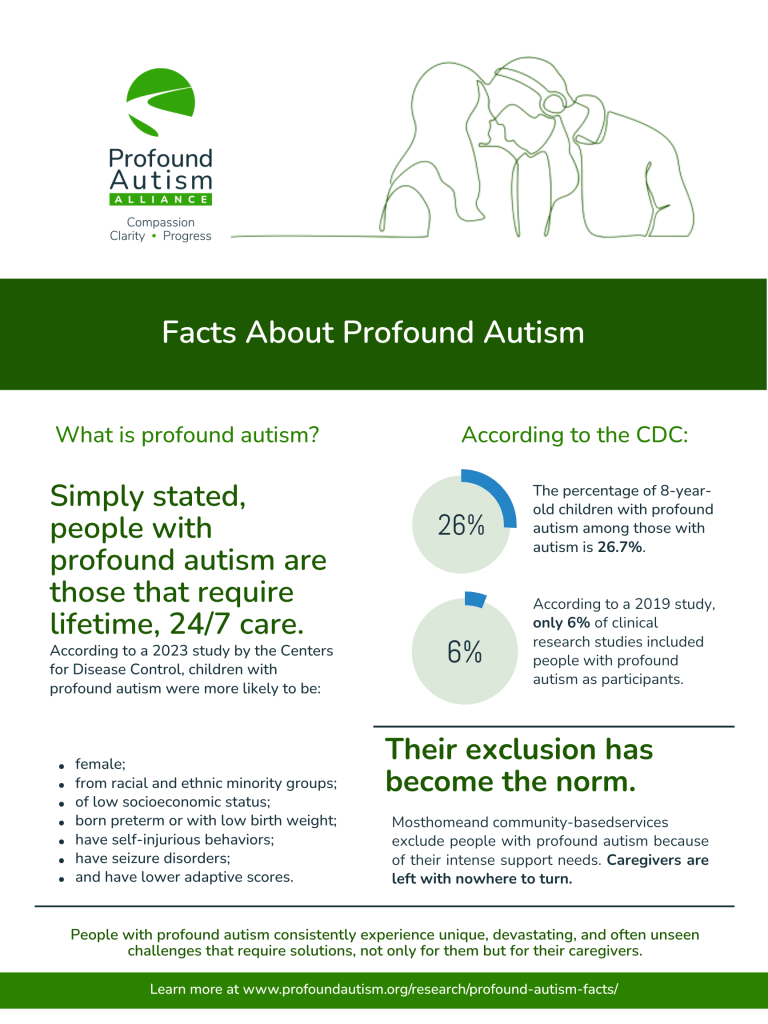
https://www.profoundautism.org/research/profound-autism-facts/
There is nothing wrong with awareness and acceptance movements but we’ve sanitized the reality of Autism along the way. We’ve mostly showed the stories of those that could participate and mask their autism and be somewhat social or successful after some interventions. Shows like Love On The Spectrum, Atypical, and The Good Doctor touched on the hardships of ASD but didn’t nearly scratch the surface of the suffering of profoundly autistic people and their families. Don’t get me wrong I loved these shows, but the fact is Profound Autism is usually left out of the conversation. If you can be on social media and share your story about how you’re able to work, have meaningful relationships and have a fulfilling life, I am not talking about you. Your story is valid and you absolutely should share it, and if you don’t want a cure that’s fine. I would wager that most profoundly autistic people do want to be cured, so they can experience those same pleasures in life.
As parents we are not saying we don’t love our children, or don’t think they’re valuable and loved just as they are…we are saying they need and deserve help. I love my daughter with my whole heart and I wouldn’t change her personality, but I see the pain behind her eyes. She cries to me and wants to tell me what’s wrong but she can’t get the words out. I’ve witnessed how traumatic and dangerous her meltdowns can be. She sees other kids socializing and doing things she can’t do and I can tell she feels a sting. Why wouldn’t I want to remove her pain?
Families deserve a choice, advocation that “we don’t want a cure” creates an environment of shame for those families who only want to remove their child’s suffering. It also discourages the need for research into treatments that can improve quality of life for those with ASD and Profound Autism. Awareness nor improved social services alone cannot remove the pain and suffering Autistic people feel every day. Parents, I’m here to tell you that It’s okay to want more out of life than just acceptance and understanding. It’s okay to grieve the life you thought you would have with your children. It’s okay to love your child no matter what and still want better for them. It’s okay to ask questions to the scientific community and envision a future without Profound Autism. It doesn’t take away the love you have for your child. The future generations deserves answers, choices, and improved health outcomes.
As a community, we can treat each other better. We should not speak for all with blanket statements when we share our opinions online. We should be considering Profound Autism when discussing ASD. We should share more of the dark side…so everyone has a seat at the table.
If you have a story to share about your experience with Autism and would like to be featured on my Stories Page please email me at atypicallifeblog@gmail.com.
Resources:
1. https://pmc.ncbi.nlm.nih.gov/articles/PMC5764584/
2. https://www-bbc-com.cdn.ampproject.org/v/s/www.bbc.com/news/articles/cevz13xkxpro.amp?amp_gsa=1&_js_v=a9&usqp=mq331AQIUAKwASCAAgM%3D#amp_tf=From%20%251%24s&aoh=17589752899872&referrer=https%3A%2F%2Fwww.google.com&share=https%3A%2F%2Fwww.bbc.com%2Fnews%2Farticles%2Fcevz13xkxpro
3. https://pmc.ncbi.nlm.nih.gov/articles/PMC10072169/
 Atypical Life
Leave a comment